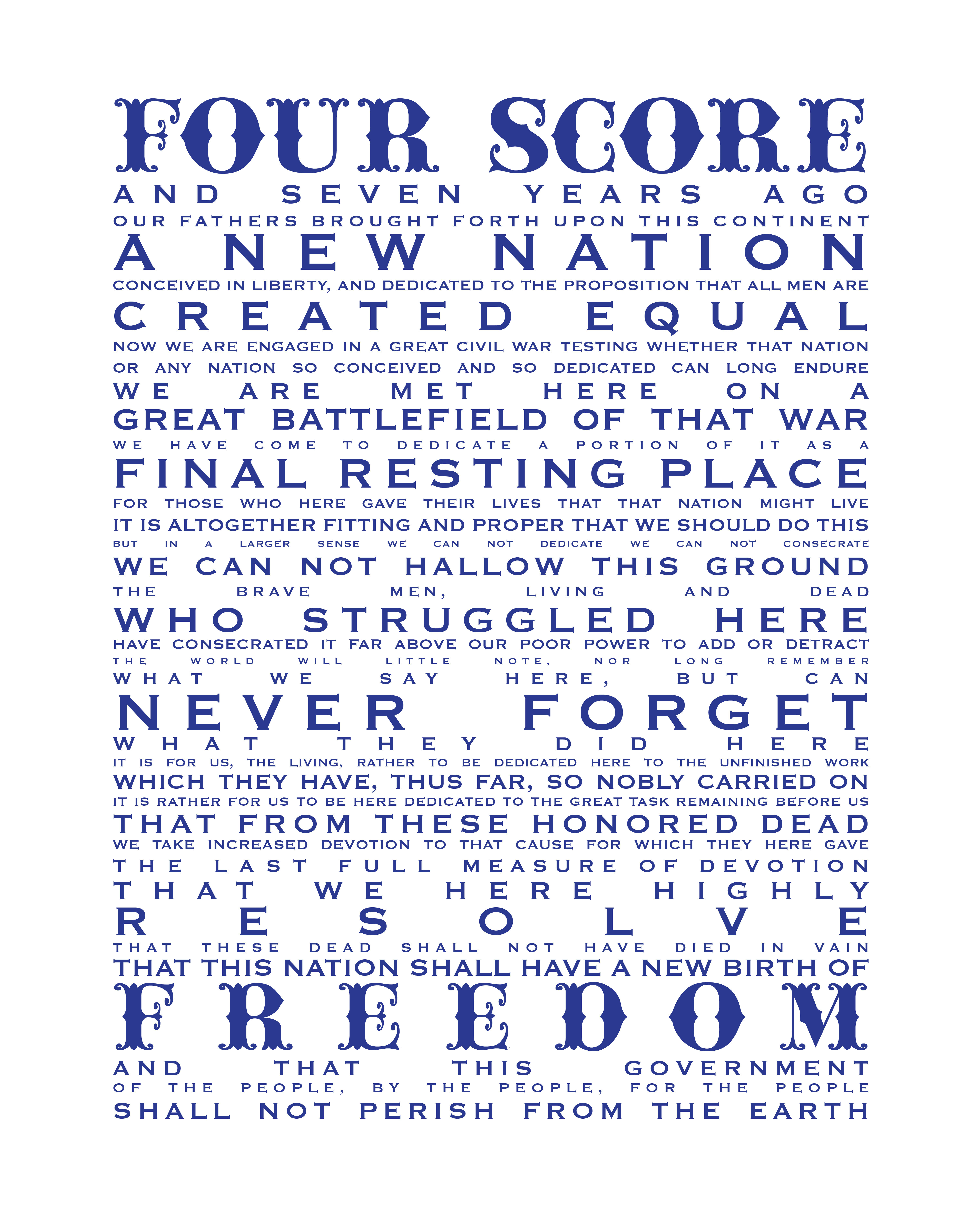
Image purchased from Announced Design
“Four score and seven years ago our fathers brought forth on this continent a new nation, conceived in liberty, and dedicated to the proposition that all men are created equal.
Now we are engaged in a great civil war, testing whether that nation, or any nation, so conceived and so dedicated, can long endure. We are met on a great battle-field of that war. We have come to dedicate a portion of that field, as a final resting place for those who here gave their lives that that nation might live. It is altogether fitting and proper that we should do this.
But, in a larger sense, we can not dedicate, we can not consecrate, we can not hallow this ground. The brave men, living and dead, who struggled here, have consecrated it, far above our poor power to add or detract. The world will little note, nor long remember what we say here, but it can never forget what they did here. It is for us the living, rather, to be dedicated here to the unfinished work which they who fought here have thus far so nobly advanced. It is rather for us to be here dedicated to the great task remaining before us—that from these honored dead we take increased devotion to that cause for which they gave the last full measure of devotion—that we here highly resolve that these dead shall not have died in vain—that this nation, under God, shall have a new birth of freedom—and that government of the people, by the people, for the people, shall not perish from the earth.”
Called everything from “dishwatery”, “silly remarks” to “one of the finest examples of English oratory”, the Gettysburg Address is commemorated today, at the 150th anniversary of its delivery.
The context:
The nation is embroiled in a long civil war, its citizens weary of the sacrifice and continued struggle. The president, having been interested in addressing the significance of the war for some time, used the invitation to help dedicate a national cemetery at the Gettysburg battlefield to deliver his message. Until July, 1863, most of the war had been fought in the south. Gettysburg represented the largest, northernmost battle and the bloodiest of the conflict, costing the combined armies approximately 50,000 casualties. The Union victory represented a turning point in the war and by October, 1863, fighting again turned south and most of the reinterment of the battle dead was complete, thanks to local efforts to turn the battlefield into a national cemetery.
Total casualties since the beginning of the war:
Union 185,010
Confederacy 211,687
Consider that for a moment. 396,697 lives lost since fighting began on April 12, 1861. By the end of the war in 1865, casualties would escalate to over 1,030,000 military and civilian deaths, representing 3% of the country’s population.
Why the history lesson, you ask? Mainly because of that question and the connotation that it has. “A History Lesson.” To many that phrase implies an overly intellectual dissertation, filled with pomposity and needless detail, most of which doesn’t matter anymore. Something to be avoided and possibly derided.
I, myself, always wondered why people find history boring. Isn’t it simply a collection of life’s stories? People get paid a lot of money to create works of fiction to read, watch and experience. And yet the masses who flock to the latest blockbuster, will often eschew much of what is deemed historical.
As someone who cultivates an appreciation for the past, I sometimes worry for our future. I’m afraid we’re evolving into a shallow and uncultured society, with little regard for art, music, history and the other social sciences. And as someone who has no children, I fret that there’s little I can do to influence future generations by instilling that appreciation in someone. Anyone.
I wish you, my friend, could experience the feeling I have when I read the speech printed above. I read it and think about that place in time, what was happening, and the impact of those happenings on the future. I think about a president beset by political, strategic and emotional difficulties, not to mention battling a form of small pox at the time. I wonder how a time of such great and terrible events could produce such a lasting lesson for us all of the importance of our democracy and the place that idea holds in the history of the world. And the simple power of those words makes me tear up every time I read it.
Some things are too important and need recognizing. History matters.
A history lesson…? Yes, please. I’ll take two.
 The Angry Suburbanite